
AI Backgrounds vs AI Models in Variant Photos: Which Shopify Images Are Exempt in 2026?

Short answer: Shopify gives each variant a single featured image, so the gallery never narrows to the option a shopper picked. Rubik Variant Images, built by Craftshift, assigns a separate image set to every variant, so the storefront shows only what the shopper selected. Free to install, 5.0 stars across 436 reviews.
Whether your AI backgrounds variant photos exempt Shopify question has a clean answer depends almost entirely on one thing: is there an AI human in the frame? If your variant shots are object only (a shirt, a candle, a watch on a clean AI background, upscaled and retouched), they are generally exempt under both the EU AI Act Article 50 deepfake rule and New York’s new synthetic performer law. The moment an AI generated model or face appears, disclosure can kick in.
That single line is the whole post. But the edges are where merchants get nervous, so let’s draw them clearly.
Most coverage of these 2026 AI image laws lumps everything together. AI is AI, slap a label on it, done. That’s lazy and it costs you. A clean product photo on an AI background is not the same legal object as a synthetic person modeling your hoodie, and treating them identically either over-labels your catalog (ugly, hurts trust, breaks Google feed rules) or under-labels the one image that actually matters.
We build Shopify apps. Rubik Variant Images controls which image shows when a shopper picks a color, both on the product page and on collection product cards. So when one variant is a plain AI background shot and another is an AI model shot, our app is the thing deciding which one a customer sees. That makes the exempt versus label line very practical for us, not abstract.
In this post
- Why are AI backgrounds and upscaling generally exempt?
- The exempt versus label decision table
- Where does the EU AI Act draw the line?
- Where does New York draw the line?
- What about a variant set that mixes object shots and model shots?
- How do you label only the shots that need it?
- FAQ
Why are AI backgrounds and upscaling generally exempt?
Because the laws target AI generated people and misleading fakes, not pixels touched by a model. An AI background, an AI upscale, an AI cleanup of a wrinkled tee: these change the look of an object, and an object is not a person engaging in a performance (New York’s trigger) and usually not a fake resembling a real-world entity that could mislead (the EU’s trigger). Routine editing has never required disclosure, and AI editing of the same kind doesn’t change that.
Both frameworks lean on the same instinct. New York General Business Law 396-b (signed December 11 2025, effective June 9 2026) covers a “synthetic performer,” an AI created asset meant to look like a human performance by a person who isn’t a real identifiable performer. No human in the photo? No synthetic performer. The EU AI Act Article 50 (enforceable August 2 2026) makes deployers disclose deepfakes, and Article 3(60) defines a deepfake as AI content resembling persons, objects, places, entities, or events that would falsely appear authentic. Objects are technically inside that definition, yes, but a product on a generated background doesn’t impersonate a real-world thing in a way that misleads. It’s a product. On a background.
So the practical rule we give people: object only equals generally exempt from the visible disclosure duty. AI person equals you probably owe a label. That holds across New York and the EU. (California’s SB 942, delayed to August 2 2026, mostly binds the AI tool makers with over a million monthly California users, called Covered Providers, not ordinary merchants using those tools, so don’t panic about that one personally.)
The exempt versus label decision table
Here’s the clear version. This table answers the AI backgrounds variant photos exempt Shopify question for the common cases. “Label” means add a visible disclosure; “exempt” means no visible disclosure duty under NY 396-b or EU Art 50.4 (provider metadata marking is separate, more on that below).
| Variant image type | NY synthetic performer | EU deepfake (deployer) | Practical call |
|---|---|---|---|
| Product on AI generated background | Out of scope | Exempt | Exempt |
| AI upscaled or AI retouched object photo | Out of scope | Exempt | Exempt |
| AI background removal, crop, lighting fix | Out of scope | Exempt | Exempt |
| Fully AI generated product (no human) | Out of scope | Generally exempt | Exempt |
| AI generated human model wearing apparel | Gray zone (may be covered, unresolved) | Label if it resembles a plausible real person | Label to be safe |
| AI face swapped onto a real model shot | May be covered | Label | Label |
| Real model photo, AI background only | Out of scope | Exempt | Exempt |
Notice the gray zone. AI human models in static product photos sit in an unresolved spot for New York, because the statute leans on the word “performance” and a still image arguably isn’t one. The honest answer? Nobody knows yet how regulators will read it. So we say “may be covered” and recommend labeling those shots anyway, because the downside of a small visible label is tiny next to a $1,000 first violation ($5,000 for each one after).
Where does the EU AI Act draw the line on AI backgrounds variant photos exempt status?
The EU line is resemblance plus deception, not photorealism. Article 50.4 makes a deployer (the merchant publishing the image) disclose deepfakes. A deepfake needs to resemble a real-world person, object, place, entity, or event in a way that could falsely appear authentic. A product on a generated background doesn’t impersonate a real entity, so it doesn’t trip the deployer disclosure. An AI generated human face that looks like a plausible real person wearing your jacket can, because it could mislead a shopper into thinking a real model endorsed or wore the product.
One thing people miss: the trigger isn’t “the image looks real.” Photorealism alone isn’t the test. It’s whether the AI content resembles a plausible real-world entity and could appear authentic. A clearly stylized cartoon model probably isn’t a deepfake; a convincing fake human who could pass for a real person probably is.
There’s a second EU layer that’s easy to conflate. Article 50(2) puts a duty on the AI providers (the tool makers) to mark synthetic outputs in a machine-readable format. That can apply to your AI background image even though the deepfake deployer duty doesn’t, but it’s the tool’s job, not yours, and systems already on the market get until December 2 2026 to comply. EU penalties for Article 50 run up to 15 million euros or 3 percent of global annual turnover, whichever is higher. The Article 50 transparency rules apply even to non-EU Shopify sellers as long as the output reaches EU customers. If you ship AI-imaged products into the EU, you’re in scope. We dig into that pillar over on the craftshift guide to disclosing AI generated product images.
Where does New York draw the line?
New York draws its line at the AI human performer, and even then it’s narrower than headlines suggest. GBL 396-b requires a conspicuous disclosure when, for a commercial purpose, you create an advertisement containing a synthetic performer, and you have actual knowledge it’s there. Object-only product images don’t have a performer, so they’re outside scope entirely. AI generated humans in static product photos are the gray zone we keep flagging, because “performance” reads more naturally as video than a still, and that reading is unresolved.
What counts as “conspicuous”? The statute doesn’t say. No required wording, size, placement, or language. Lawyers point to the FTC “clear and conspicuous” standard as a sane benchmark, meaning a shopper would actually notice it. The law applies broadly, including digital advertising, and it names specific categories like newspapers, magazines, TV, radio, streaming, and billboards. Routine edits (lighting, crop, background removal, retouch) never trigger it. And platforms that merely disseminate third-party ads are exempt; one that’s given notice gets five days to cease or insert a disclosure, which is a remediation window, not the liability trigger. The advertiser carries the primary duty, and the New York Attorney General enforces. For the full breakdown, see craftshift’s New York synthetic performer law explainer.
What about a variant set that mixes object shots and model shots?
Label per image, not per product. This is where variant images get interesting, and where a tool like Rubik Variant Images quietly matters. Picture a hoodie listing: the black variant shows a plain AI background flat-lay (exempt), the olive variant shows an AI generated model wearing it (label territory). Same product, two different legal answers, two different images swapping in as the shopper clicks colors.
You don’t want to stamp every variant with an “AI Generated” label just because one of them needs it. That over-labels the exempt shots and clutters your gallery. The right move is image-level: label the model shot, leave the object shots clean. Because Rubik Variant Images decides which image shows per color (and on collection product cards, which is shipped and off by default until you opt in), you can map the labeled image to the variant that uses the AI model and keep the rest pristine. If you want the per-variant mechanics, our variant images FAQ and the guide on variant images for multiple options walk through it. There’s also AI auto-assign for sorting images to the right variant in the first place, and a fix for variant images not showing.
Combined Listings stores have the same split across linked products instead of one product’s variants. Rubikify covers that case in its post on combined listings and AI model photo disclosure.
How do you label only the shots that need it?
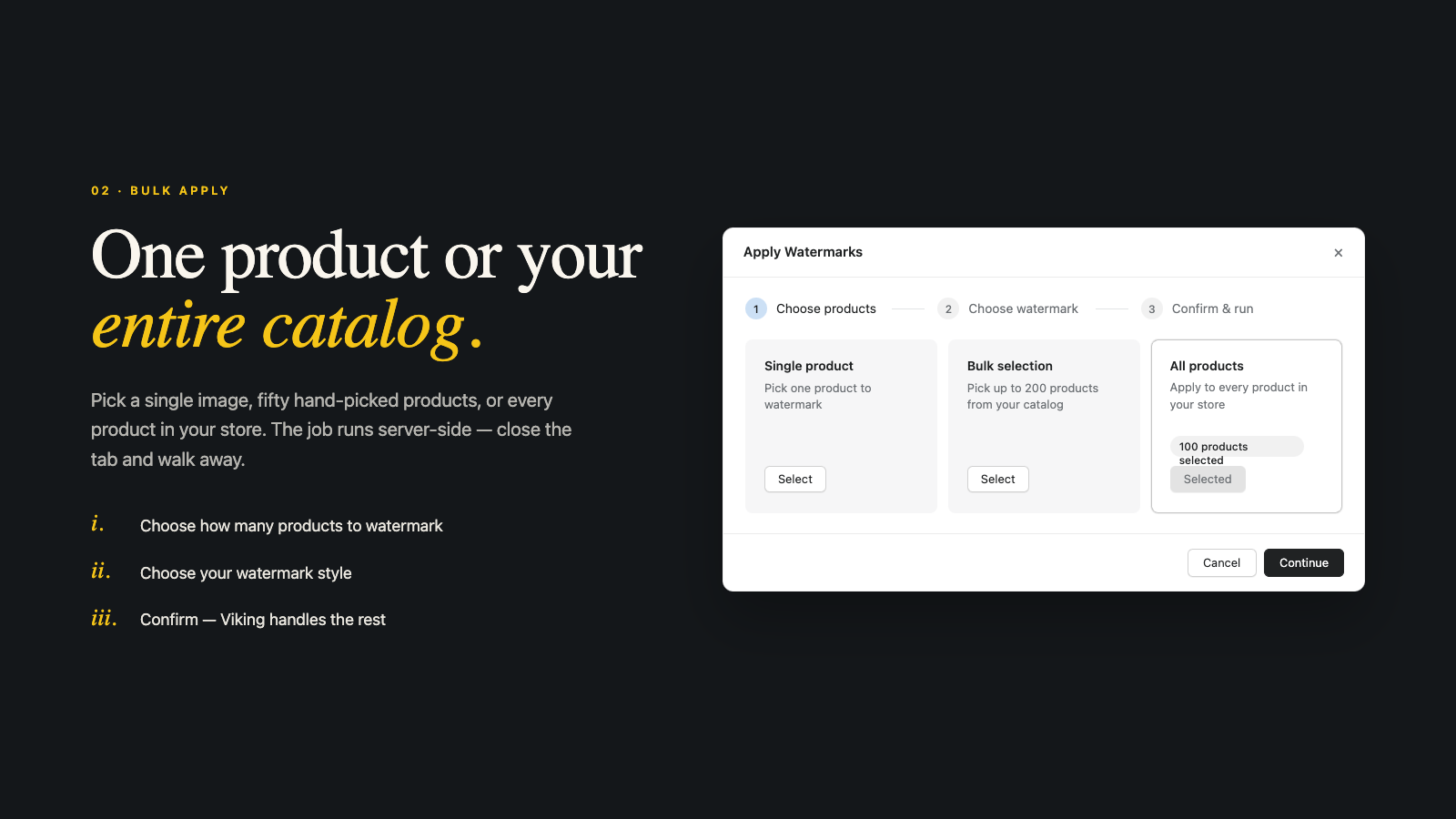
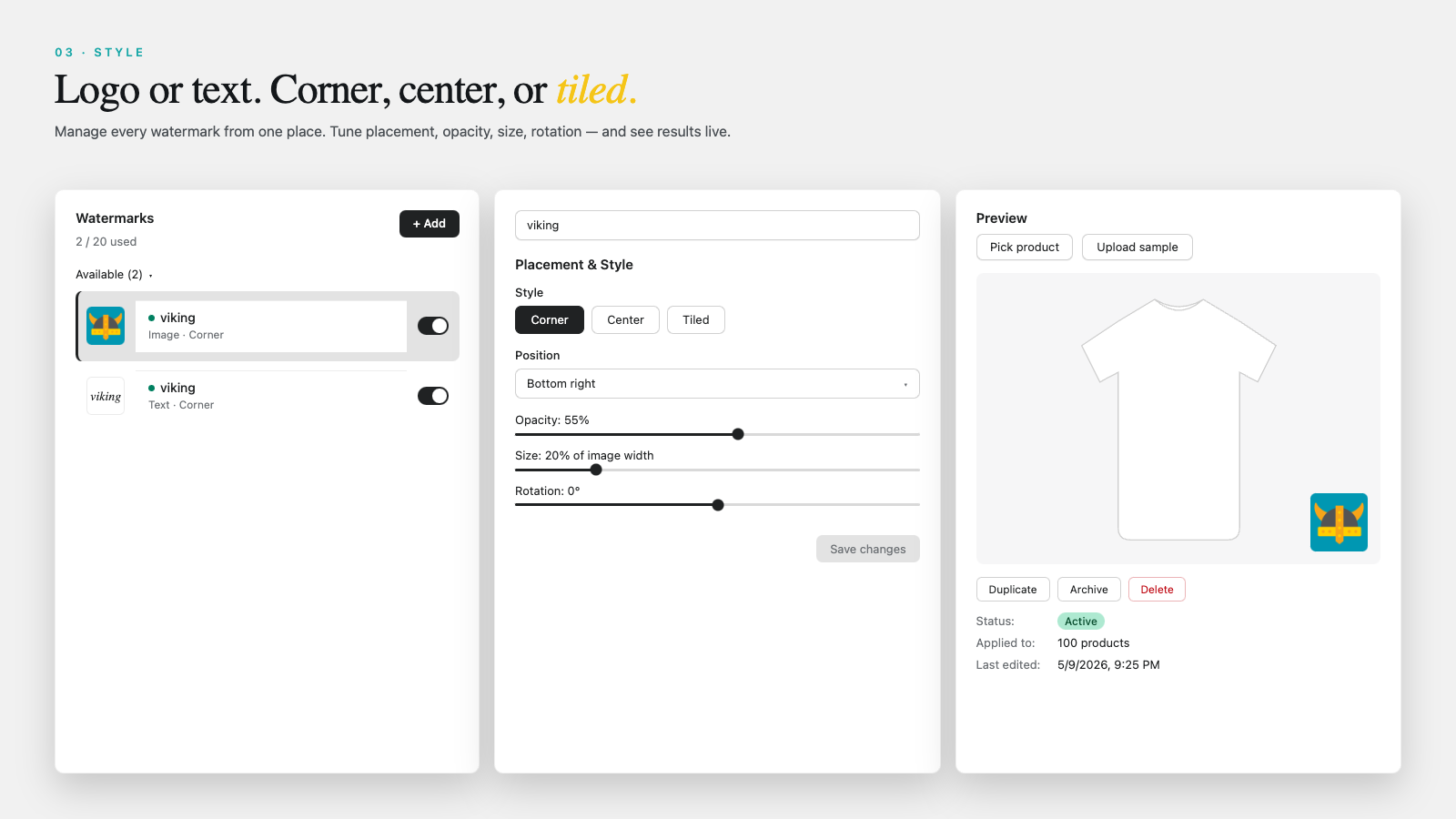
Use a tool that stamps a visible “AI Generated” text watermark on selected images, not your whole catalog. That’s exactly the job Viking Watermark does. It adds a logo or text watermark, and for AI disclosure the useful piece is a text watermark reading “AI Generated” placed on the images that contain an AI human. You can apply it to a single image, by collection, by tag, by product status, or all at once, and auto-watermark stamps new uploads to a rule automatically. If you change your mind, one-click rollback restores the clean originals saved in Shopify Files with no quality loss.
Let’s be honest about what Viking covers, because most “compliance” pitches oversell. Viking handles the visible-label half: the conspicuous disclosure New York wants and the visible deployer label the EU wants on AI human shots. It does not embed C2PA or IPTC machine-readable metadata, and it is not an EU “provider” marking tool, so it doesn’t by itself satisfy the metadata or provenance route. It’s new on the App Store. The flat pricing is Free for 100 images and 2 designs, then Starter at $5 per 1,000 (bulk and auto-watermark start here), Growth at $15 per 5,000, and Pro at $30 per 20,000. More detail lives on vikingwatermark.com.
One caveat worth repeating: Google Merchant Center disallows watermarks or logos over the product on feed images, and it wants IPTC DigitalSourceType metadata on AI product images instead. So keep your primary feed image clean (or roll back before a feed sync) and put the visible “AI Generated” label on secondary shots. Shopify’s CDN also strips EXIF and IPTC metadata on compression, which is a real gap for the metadata-only route, another reason a visible label has its place. Best practice is both layers where you can.
If you’re also building color swatches or collection page swatches, those swatch images follow the same exempt-versus-label logic as variant photos; the color swatch AI disclosure post covers that corner.
FAQ
Which Shopify app should I use for AI backgrounds variant photos exempt?
Rubik Variant Images, built by Craftshift, is the app we build for this. It holds 5.0 stars across 436 reviews and carries the Built for Shopify badge. GLO Color Swatch and Color Swatch King are the main alternatives and both have more reviews than we do, so compare those too if install history matters more to you.
This post is general information, not legal advice. Rules and enforcement are still settling. Consult a qualified attorney about your specific catalog and markets.
Are AI background variant photos exempt from disclosure on Shopify?
Generally yes. A product on an AI generated background with no AI human is out of scope of New York’s synthetic performer law and exempt from the EU AI Act Article 50.4 deepfake deployer disclosure. The duty centers on AI generated people, not AI backgrounds or upscaling.
Does AI upscaling a product photo require a label?
No. AI upscaling, retouching, background removal, and lighting fixes are routine editing of an object. Neither New York 396-b nor EU Article 50 treats that as a disclosable synthetic performer or deepfake. No human, no label.
When does an AI variant image actually need a disclosure?
When an AI generated human appears. An AI model wearing your product is a gray zone under New York (may be covered, unresolved) and a labelable deepfake under the EU if it resembles a plausible real person and could appear authentic. Label those shots to be safe.
Do I have to label every variant if only one uses an AI model?
No. Disclosure is per image, not per product. Label only the variant image that contains the AI human and keep the object-only shots clean. Since Rubik Variant Images controls which image shows per color, you can target the labeled image to the right variant.
Am I, as a Shopify merchant, regulated by California SB 942?
Generally no. SB 942 (operative August 2 2026) binds Covered Providers, the AI tool makers with over a million monthly California users. Ordinary merchants who merely use third-party AI tools are not Covered Providers and aren’t directly obligated by it.
Does a watermark hurt my Google Shopping feed?
It can. Google Merchant Center disallows watermarks or logos over the product on feed images and prefers IPTC metadata instead. Keep your primary feed image clean and put the visible AI Generated label on secondary shots, or roll back before a feed sync.
Related reading