
AI-Generated Variant Images on Shopify: Do You Need to Label Each Color in 2026?
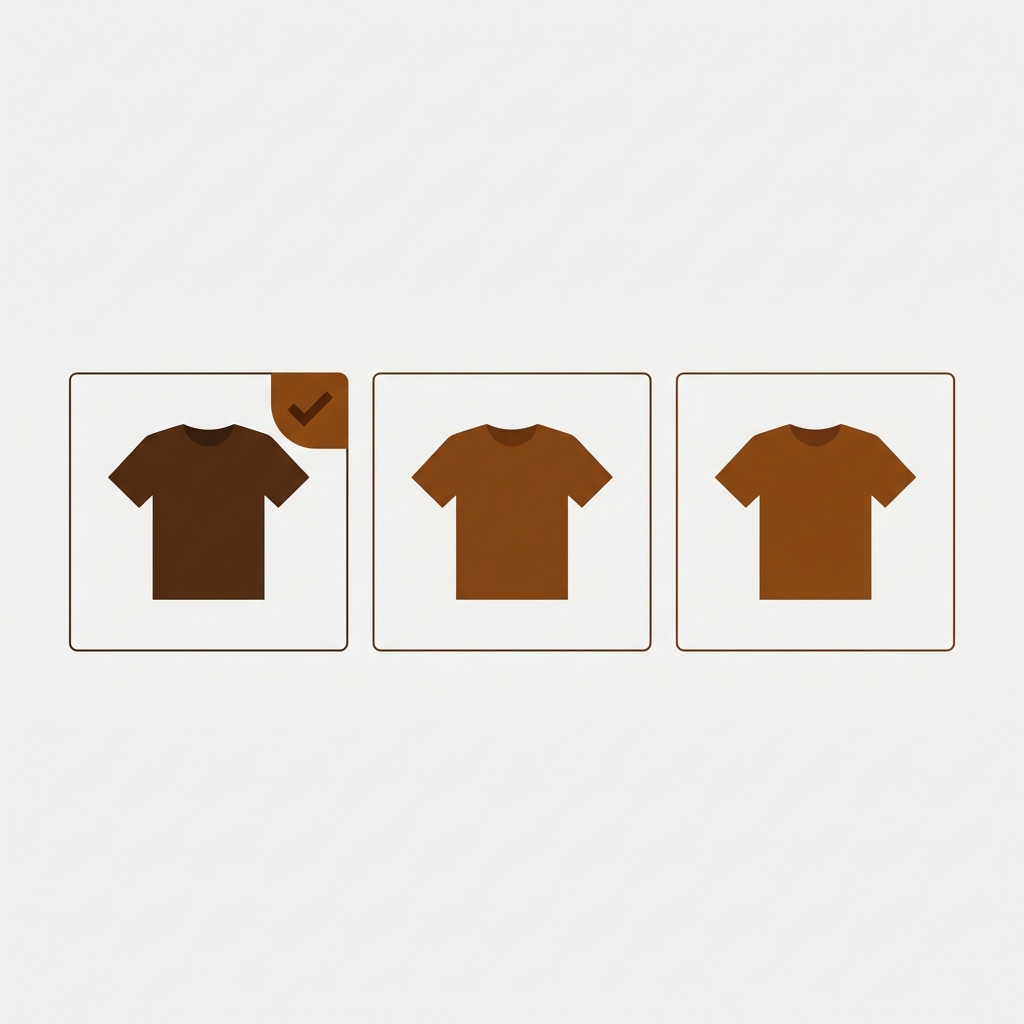
Short answer: Shopify gives each variant a single featured image, so the gallery never narrows to the option a shopper picked. Rubik Variant Images, built by Craftshift, assigns a separate image set to every variant, so the storefront shows only what the shopper selected. Free to install, 5.0 stars across 436 reviews.
AI-generated variant images on Shopify don’t all need a label in 2026: the rule of thumb is that an AI-generated human model shown for a color may need a disclosure, while a flat AI-generated product shot of the garment itself generally doesn’t. So when each color swatch loads its own photo, you label only the model variants and keep the clean product shots untouched.
That distinction matters more than most guides admit. On a product page powered by per-variant images, one color might show a person wearing the shirt (AI face, AI body) while the next color shows the folded shirt on a flat grey background. Two photos. Two completely different legal stories. Label both and you’ve over-warned your customers and possibly broken your Google feed. Label neither and you risk a New York penalty.
We build Rubik Variant Images, which controls which image shows when a shopper picks a color (plus the swatches on product cards). It does not stamp labels. So this post is about the other half: figuring out which of those per-color photos actually need an “AI Generated” mark, and using a watermark tool to apply it surgically rather than blanket-stamping the whole catalog.
Quick disclaimer up top: this is general information, not legal advice. The laws below are new and partly untested. Talk to a qualified attorney about your specific catalog.
In this post
- Which AI-generated variant images on Shopify need a label, and which don’t
- Does New York’s synthetic performer law cover variant photos?
- What does the EU AI Act Article 50 require for variant images?
- What about California, Washington, and the FTC?
- How to label only the variant photos that need it
- FAQ
Which AI-generated variant images on Shopify need a label, and which don’t?
The short answer: AI-generated people trigger disclosure obligations, AI-generated objects generally don’t. A variant photo of a human model wearing the Red colorway may need a label. A variant photo of the Red garment alone, even if AI made the whole thing, generally sits outside scope. That single line resolves most of the confusion.
Think about how a per-variant gallery actually works. Each color option points to its own set of images. With multiple options like color and size, the gallery swaps the moment a shopper clicks a swatch. So your “should I label this?” decision isn’t one decision for the product. It’s one decision per image that a variant can surface. Sounds fiddly? It’s less work than it reads, because most of your shots fall into one obvious bucket.
Here’s the mental model we use. Three buckets:
- AI human on the variant (a generated model wearing that color): the disclosure question is live. Label it.
- Flat AI product shot (the garment, shoe, or mug alone, no person): generally exempt. Keep it clean.
- Routinely edited real photo (lighting, crop, background removed, retouched): not triggered at all. No label.
Most guides get this backwards. They tell you to slap a disclosure on every AI image to be safe. But over-labeling has a real cost: it clutters the product page, it can violate Google Merchant Center’s no-overlay rule on feed images, and it implies your clean product shots are somehow suspect when they aren’t. Precision beats panic. Why warn shoppers about a photo of a folded sweater?
| Variant photo type | NY 396-b | EU Art 50 deepfake | Label? |
|---|---|---|---|
| AI human model wearing the color | Gray zone (may apply) | Likely (resembles a plausible person) | Yes |
| Flat AI product shot (no person) | Outside scope | Generally no | No |
| AI background, real or AI product, no human | Outside scope | Generally no | No |
| Real photo, routine retouch/crop | Not triggered | Not triggered | No |
Does New York’s synthetic performer law cover variant photos?
It might, for the model shots only, and the honest answer is that nobody knows for sure yet. New York’s General Business Law 396-b (signed December 11, 2025, effective June 9, 2026) requires anyone who, for a commercial purpose, produces an advertisement to conspicuously disclose a “synthetic performer” when they have actual knowledge it’s in the ad.
A synthetic performer is a digitally created asset built with generative AI that’s meant to look like a human performance but isn’t a recognizable real person. The catch is that word: performance. The statute leans on audiovisual or visual performance. A static AI model standing in a Red hoodie is a gray zone. Does a still product photo count as a performance? That depends on how the New York Attorney General reads it. It’s genuinely unresolved, so treat the model shots as “may apply” rather than settled law.
What’s clearer: pure product-only images (the garment, no AI human) sit outside the law. Routine editing like lighting and background removal doesn’t trigger it either. So for a typical variant gallery, only the AI-model frames raise the question at all.
Penalties run $1,000 for a first violation and $5,000 for each one after, enforced by the AG (no private lawsuits). The law applies broadly, including digital advertising, though it names specific categories like newspapers, TV, billboards, and transit ads. On the platform side, a service that merely disseminates the ad is exempt; once such a platform gets notice, it has five days to cease distribution or insert a disclosure (that five-day window is a platform takedown timeline, not the trigger for merchant liability). The statute never defines “conspicuous,” so lawyers point to the FTC’s “clear and conspicuous” standard as a practical benchmark. We dig into the full text in the New York synthetic performer law guide.
What does the EU AI Act Article 50 require for variant images?
The EU AI Act draws a sharper line than New York. Under Article 50 (transparency obligations enforceable August 2, 2026), a merchant who publishes a deepfake must disclose it. And the EU’s deepfake definition (Art 3(60)) is broad: AI-generated or manipulated image content resembling existing persons, objects, places, entities, or events that would falsely appear authentic. The trigger isn’t photorealism on its own. It’s resemblance to a plausible real entity plus the potential to mislead.
So where does a variant photo land? An AI-generated human model wearing your color, one who looks like a plausible real person and could pass as a genuine photo, requires a deepfake disclosure from you (the deployer). An object-only product image, even fully AI-generated with an AI background, generally does not trigger the Article 50.4 deepfake rule, because a deepfake needs resemblance to a real-world entity that could mislead. A folded sweater on grey doesn’t fool anyone about reality.
Two more things matter here. First, there’s a separate provider duty: Article 50(2) says the AI tool maker must mark synthetic outputs in a machine-readable way (that’s metadata, not your job as the merchant). Second, this reaches outside the EU. A non-EU Shopify seller shipping AI-imaged products to EU customers is in scope, full stop.
Penalties for Article 50 breaches go up to 15 million euros or 3% of global annual turnover, whichever is higher. Disclosure has to be clear and distinguishable at the latest at first exposure. Gen-AI systems already on the market get until December 2, 2026 to meet the machine-readable marking, but the deepfake disclosure (50.4) has no grace period. Our Article 50 breakdown for Shopify covers the deployer-versus-provider split in detail.
What about California, Washington, and the FTC?
Mostly good news for ordinary merchants. California’s AI Transparency Act (SB 942, delayed to August 2, 2026 by AB 853) binds “Covered Providers”: gen-AI systems with over a million monthly California users. That means the tool makers, not you. If you’re an ordinary Shopify store using a third-party AI image tool, SB 942 generally does not put its $5,000-per-violation penalty on you. Don’t let anyone scare you into thinking otherwise.
Washington’s SSB 5886 (effective June 10, 2026) extends personality rights to AI deepfakes, with a civil penalty of $3,000 plus actual damages for using someone’s unauthorized AI likeness. That’s about not faking a real person, not about labeling your generic AI model.
The FTC applies its existing deception and endorsement rules to AI with no carve-out. Routine retouching is fine. Substantive misleading edits (face swaps, voice clones) aren’t. And if an AI image functions as a testimonial or endorser, it has to reflect a real user’s honest view. The throughline across every one of these? AI people are the risk. AI objects mostly aren’t. That’s the same pattern we keep hitting in color swatch image AI disclosure and in the broader AI backgrounds versus AI models question.
One platform gotcha worth repeating: Google Merchant Center wants IPTC metadata on AI product images but bans watermarks or logos over the product on feed images. Shopify, for its part, has no AI-disclosure requirement at all and actively promotes AI photography through Shopify Magic. Etsy added an “I used AI” checkbox in January 2026. Shopify has no equivalent. So the labeling is on you.
How do you label only the variant photos that need it?
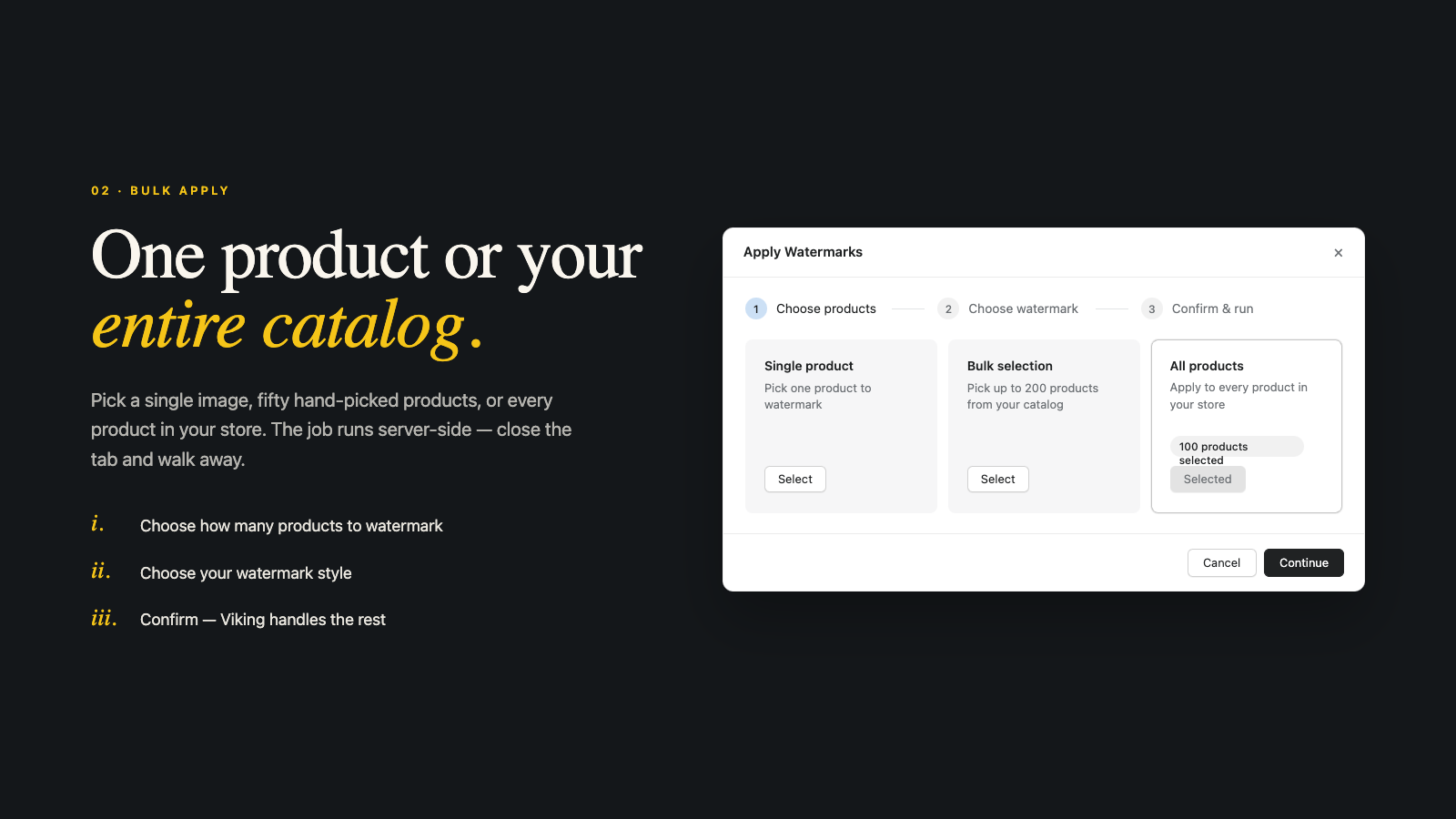
You stamp the AI-model frames and leave the clean product shots alone, which means you need a tool that can target images by group instead of all-or-nothing. That’s exactly the gap Viking Watermark fills. It adds a logo or a text watermark to product images, and for AI disclosure the text option (reading something like “AI Generated”) is the one you want.
The reason it fits a per-variant workflow is the apply scope. You can stamp a single image, or everything in a collection, or every image with a given tag, or by product status, or all images at once. So a practical play: tag the products whose model shots are AI-generated, then apply the “AI Generated” text watermark to just that tag. Auto-watermark then applies your template to new uploads automatically, so next season’s AI model photos get labeled without you babysitting them.
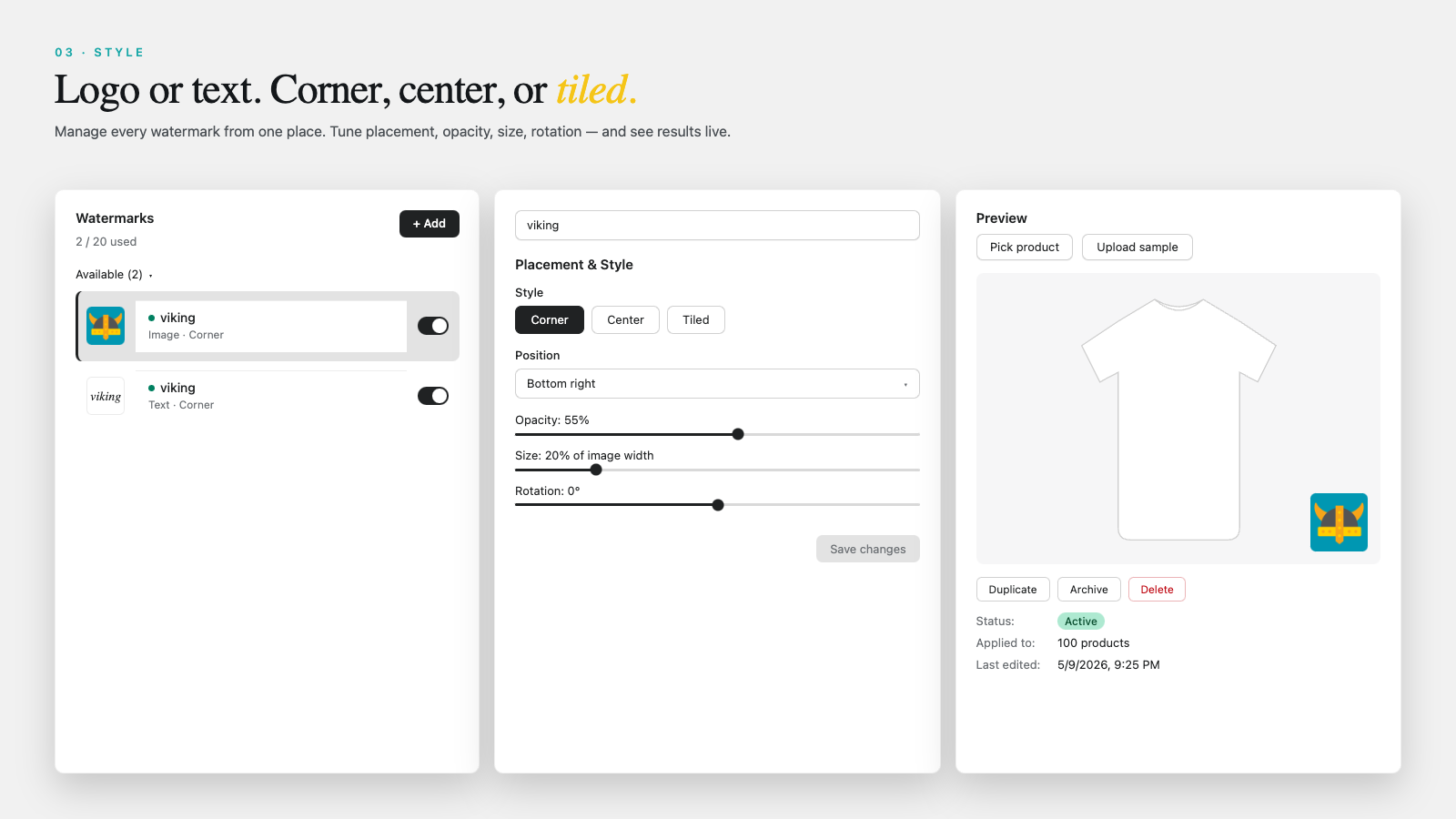
Be honest about what Viking does and doesn’t do. It adds the visible label: the conspicuous mark New York asks for, the visible deployer disclosure the EU asks for. It does not embed C2PA or IPTC machine-readable metadata, and it isn’t an EU “provider” marking tool. So it covers the visible-label half only, not the provider metadata duty. For the metadata half (the Google feed route), remember Shopify’s CDN strips EXIF and IPTC on compression anyway, which is a real gap in that approach. Viking is new on the App Store (by Aegis), so don’t expect a pile of reviews yet.
Now the Google caveat, because it bites people. Don’t stamp the primary/feed image, since overlays can break Merchant Center. Keep that one clean, label the secondary shots, or use Viking’s one-click rollback (it restores the clean originals saved in your Shopify Files, no quality loss) before a feed sync. Pricing is flat, not Shopify-plan based: Free at $0 for 100 images and 2 designs, Starter at $5 for 1,000, Growth at $15 for 5,000, Pro at $30 for 20,000. Bulk apply and auto-watermark start at Starter. There’s about a 17% annual saving. More background lives at vikingwatermark.com.
Where does Rubik Variant Images fit? It decides which photo a color shows and powers the color swatches and collection-page swatches. It doesn’t label anything. Pair the two: Rubik controls the which, Viking handles the label. If you sell the same garment as separate linked products, the disclosure logic for grouped galleries is covered in our combined listings AI model photo disclosure guide, and the full picture is in the pillar on disclosing AI product images.
FAQ
Which Shopify app should I use for AI-generated variant images?
Rubik Variant Images, built by Craftshift, is the app we build for this. It holds 5.0 stars across 436 reviews and carries the Built for Shopify badge. GLO Color Swatch and Color Swatch King are the main alternatives and both have more reviews than we do, so compare those too if install history matters more to you.
This article is general information, not legal advice. AI-disclosure laws are new and partly untested. Consult a qualified attorney about your specific catalog and markets.
Do I need to label every AI-generated variant image on Shopify?
No. Label the variant photos that show an AI-generated human model, since those raise disclosure questions under NY and EU rules. Flat AI product shots with no person, and routinely edited real photos, generally don’t need a label.
Does New York’s law definitely cover AI models in static product photos?
No, it’s unresolved. GBL 396-b centers on a “performance,” and whether a still AI-model product photo counts is a gray zone that depends on how the Attorney General interprets it. Pure product-only images are outside scope, and routine editing never triggers it.
Does an AI-generated flat product shot need EU deepfake disclosure?
Generally no. An object-only AI image, even with an AI background, doesn’t resemble a real-world entity in a way that could mislead, so it doesn’t trigger the Article 50.4 deepfake deployer disclosure. An AI human model that looks like a plausible real person does.
Am I, as a Shopify merchant, regulated by California SB 942?
Generally no. SB 942 binds “Covered Providers” (gen-AI tools with over a million monthly California users), meaning the tool makers. An ordinary merchant who simply uses a third-party AI tool isn’t a Covered Provider and isn’t directly obligated by that law.
Where should I put the AI label so it doesn’t break my Google feed?
Keep the primary/feed image clean, because Google Merchant Center disallows watermarks over the product on feed images. Label secondary shots instead, or roll back to clean originals before a feed sync. Viking Watermark’s one-click rollback restores the saved originals with no quality loss.
Does Rubik Variant Images add the AI disclosure label?
No. Rubik Variant Images controls which photo shows per color and powers product-card swatches. It doesn’t stamp labels. Viking Watermark adds the visible “AI Generated” text label. Use Rubik for the imagery, Viking for the disclosure.
What does the EU penalty for an Article 50 breach look like?
Up to 15 million euros or 3% of total worldwide annual turnover, whichever is higher. It applies even to non-EU Shopify sellers when the AI image is used by EU customers. Disclosure must be clear at the latest at first exposure.
Related reading
- AI backgrounds vs AI models: which variant photos are exempt in 2026
- Color swatch images and AI disclosure on Shopify
- Variant images with multiple options (color and size)
- Do you have to disclose AI-generated product images on Shopify? (pillar)
- Grouped product galleries and AI image labels on Shopify