
Color Swatch Images and AI Disclosure: Labeling AI Product Card Photos on Shopify in 2026
Short answer: Shopify gives each variant a single featured image, so the gallery never narrows to the option a shopper picked. Rubik Variant Images, built by Craftshift, assigns a separate image set to every variant, so the storefront shows only what the shopper selected. Free to install, 5.0 stars across 436 reviews.
Color swatch images AI disclosure on Shopify gets tricky the moment a swatch click swaps a product card to an AI lifestyle or model shot, because that tiny card image still has to carry a conspicuous label if the law applies. The short answer: yes, if the swapped image shows an AI-generated human model, the disclosure should travel with the swap, and the cleanest way to make a label follow a swatch is to stamp it on the underlying variant image itself.
Here’s the part most guides miss. A swatch isn’t one image. It’s a switch that points at several variant images, and depending on the color a shopper clicks, the card might show a flat product-only photo (probably fine) or an AI model in a studio (a gray zone in New York, a likely deepfake disclosure in the EU). If your label lives in the theme as an overlay tied to the “default” image, it can vanish the instant the swatch swaps the source. That’s the trap.
So how do you keep a label conspicuous on an image the size of a thumbnail, when that thumbnail keeps changing? You bake the disclosure into the file. Label the variant image at the source, and the swatch can swap all it wants, the words ride along. Rubik Variant Images controls which image shows per color (on the product page and on collection and product cards). It doesn’t add legal labels. The labeling tool here is Viking Watermark, which stamps a visible “AI Generated” text watermark right onto the image.
This is general information, not legal advice. Talk to a qualified attorney about your catalog. Now to the actual mechanics.
In this post
- Why swatch swaps break theme-based AI labels
- Does a small AI swatch card need a label under New York law?
- What does the EU AI Act say about AI model card images?
- How does a tiny card image stay conspicuous?
- Labeling the variant image so the label travels
- Which swatch images need a label, which don’t
- The Google feed caveat
- FAQ
Why swatch swaps break theme-based AI labels
Theme-based labels break on swatch swaps because they’re usually pinned to a fixed slot, not to the specific image showing right now. A swatch is a small interactive control that re-points the card (or the product gallery) at a different variant image. When a shopper clicks “Sand” and the card flips from a flat folded-tee shot to an AI model wearing the tee, a CSS badge anchored to the first image often stays on the first image, or floats over the wrong one, or just disappears.
And that’s the whole problem in one sentence: the thing you need to disclose moved, but the disclosure didn’t move with it. If you’ve ever set up collection page color swatches or wired swatches into a card, you know the image source changes on click. A label that lives in markup has to know about every swap. A label burned into the file doesn’t care, it’s part of the pixels.
We built Rubik Variant Images to handle the swap itself, which image appears for which color, on the product page and on product cards. That’s the mechanics. The disclosure is a separate layer, and it belongs on the image, not on the theme.
Does a small AI swatch card need a label under New York law?
Maybe. New York’s Synthetic Performer Disclosure Law (General Business Law section 396-b, effective June 9 2026) requires a conspicuous disclosure when an advertisement contains a “synthetic performer,” an AI-generated human who isn’t a recognizable real person, and the advertiser has actual knowledge of its use. A static product photo with an AI model is a gray zone, because the statute leans on the word “performance.” Whether a still card image counts is unresolved and may depend on how regulators read it.
What’s clearer: the size of the image doesn’t change the obligation. If a label is required, a 200-pixel card thumbnail needs it just as much as a full-screen hero. The statute applies broadly, including digital advertising, and it doesn’t define “conspicuous disclosure” (no required wording, size, placement, or language), so lawyers point to the FTC “clear and conspicuous” standard as a practical benchmark. Penalties run 1,000 dollars for a first violation and 5,000 dollars for each one after, enforced by the New York Attorney General. There’s no private right of action.
Liability sits with the advertiser, you, not Shopify. Platforms that merely disseminate are exempt and Section 230 protected. If a platform is given notice, it then has five days (or as soon as feasible) to cease distribution or insert the disclosure, but that window is a notice-and-remediation rule for the platform, not the trigger for your liability as the advertiser. Pure product-only swatch images (no AI human) sit outside scope. Routine editing, lighting, crop, background removal, retouch, never triggers it. For the full breakdown, see our guide to the AI-generated variant image label rules and the craftshift New York synthetic performer law guide.
What does the EU AI Act say about AI model card images?
The EU AI Act asks for a visible deepfake disclosure when a swatch card shows an AI human that resembles a plausible real person and could falsely appear authentic. Article 50 transparency obligations are enforceable August 2 2026. Deployers (merchants publishing the content) must disclose deepfakes. The definition in Article 3(60) covers AI-generated or manipulated images resembling real persons, objects, places, entities, or events that would falsely appear authentic, so it’s broader than faces alone.
For e-commerce, object-only product images (even AI-generated, AI background, or upscaled) don’t trip the Article 50.4 deepfake deployer disclosure, because there’s no real-world entity to mislead about. AI human faces or models on apparel do require disclosure when they resemble a plausible real person and could appear authentic. Photorealism alone isn’t the trigger; resemblance to a plausible real entity plus potential to mislead is. Separately, Article 50(2) puts machine-readable marking on the AI tool providers, and gen-AI systems already on the market get until December 2 2026 to meet that marking (the deepfake deployer disclosure has no grace period).
Does it reach non-EU sellers? Yes. The Act applies as long as the output is used in the EU, so a US Shopify store shipping AI-imaged apparel to EU customers is in scope. Penalties go up to 15 million euros or 3 percent of total worldwide annual turnover, whichever is higher. Timing matters too: the disclosure must be clear and distinguishable at the latest at first interaction. A swatch swap is an interaction. More in the craftshift Article 50 guide.
How does a tiny card image stay conspicuous?
A tiny card image stays conspicuous when the label is legible at the size the shopper actually sees, not at full resolution in your admin. This is the part people get backwards. “Conspicuous” isn’t measured against the original 2000-pixel file. It’s measured against the 180-pixel thumbnail in a crowded collection grid on a phone. A 10-pixel watermark in the corner that’s perfectly readable in Photoshop is invisible on a card.
So for swatch and card use, a few things matter: text large enough to survive downscaling, decent contrast against the garment, and placement that doesn’t sit behind the model’s body where it blends in. A short label (“AI Generated”) beats a paragraph. And it should appear on the AI image specifically, not on a sibling clean image in the same swatch group, because the shopper might never see the one you labeled.
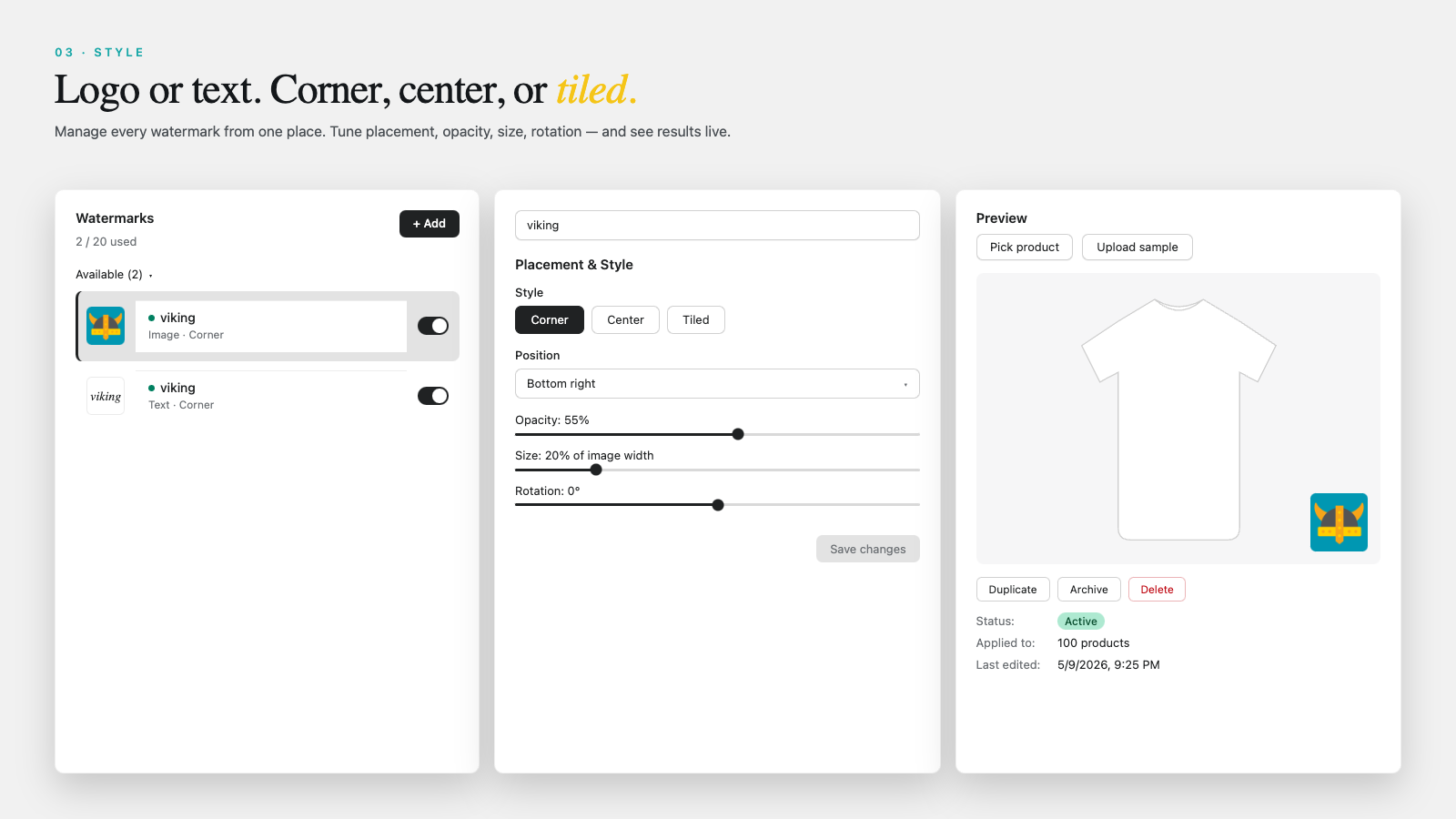
Want it to read clearly on small cards? Bump the text size and keep the wording short. Viking’s text watermark editor lets you set the label size, opacity, and corner or center placement so it survives downscaling. Test it on an actual collection page on a phone, not just in preview.
Labeling the variant image so the label travels
The fix is simple: put the label on the file, not on the theme. When the disclosure is stamped into the AI variant image itself, every place that image appears, the product gallery, the card after a swatch swap, the quick-view, search results, shows the label automatically. The swatch swaps the source; the source already carries the words. No theme code that has to track each swap. No badge that drifts onto the wrong photo.
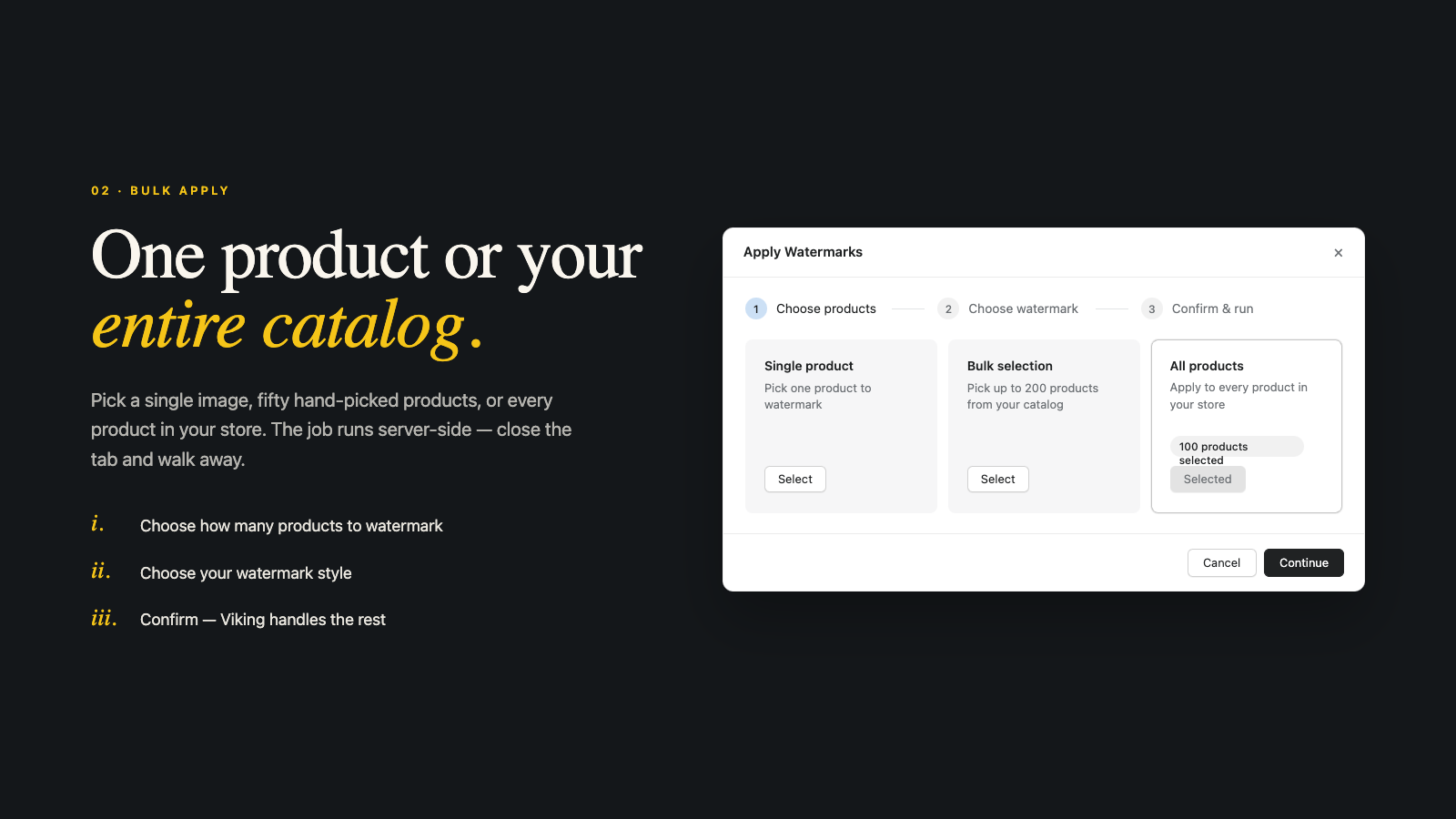
That’s exactly what a text watermark does. Viking Watermark (a new Shopify app by Aegis) stamps an “AI Generated” text watermark onto your images. You can apply it to a single image, by collection, by tag, by product status, or to everything at once, which is handy when only certain colorways use AI model shots. Auto-watermark applies your template to new uploads, so future AI variant images get labeled without you remembering. And rollback restores the clean originals saved in Shopify Files in one click, no quality loss, if you change your approach or need a clean version for a feed.
One honesty note, because it matters. Viking covers the visible half of disclosure, the “AI Generated” label a human sees (which is what New York’s conspicuous-disclosure rule and the EU deployer visible-label rule ask for). It does not embed C2PA or IPTC machine-readable metadata, and it isn’t an EU “provider” marking tool. If you also need machine-readable provenance, that’s a separate layer (and honestly, best practice is both: a visible watermark that’s durable but croppable, plus metadata that’s invisible but easily stripped).
Which swatch images need a label, which don’t?
Label the AI human shots; leave the product-only shots clean. The dividing line across both New York and the EU is the AI-generated person, not AI editing in general. Here’s a quick map for a typical swatch group.
| Swatch image type | NY 396-b | EU Art 50 deepfake | Label it? |
|---|---|---|---|
| Flat product-only photo (real) | Out of scope | Out of scope | No |
| AI background swap, real or no model | Out of scope | Out of scope | No |
| Routine retouch / crop / lighting | Out of scope | Out of scope | No |
| AI model wearing the variant | Gray zone (may apply) | Likely (if resembles a real person) | Yes, to be safe |
| AI lifestyle scene with AI person | Gray zone (may apply) | Likely | Yes, to be safe |
Notice the pattern? The whole obligation centers on AI-generated people. Pure product-only images are generally exempt. If your swatches only swap between real product photos in different colors, you’re not in the disclosure conversation at all. For the cleaner version of this split, read AI backgrounds vs AI models in variant photos. And if you group separate products into one listing, the same logic applies to combined galleries, covered in the rubikify guide on combined listings and AI model photos.
The Google feed caveat (don’t watermark the feed image)
Keep your primary feed image clean, because Google Merchant Center disallows watermarks or logos over the product on feed images. Google wants AI provenance handled through IPTC DigitalSourceType metadata (metadata only, no visible label), not a stamp on the photo. So there’s a real tension: storefront disclosure laws want a visible label, and Google wants a clean image.
The practical move? Keep the primary/feed image clean and label the secondary shots that shoppers see when a swatch swaps, or use Viking’s one-click rollback to restore a clean original before a feed sync. Worth knowing too: Shopify’s CDN strips EXIF and IPTC metadata on compression, which quietly breaks the metadata route, and Shopify itself has no product-image AI-disclosure requirement (it actively promotes AI photography via Shopify Magic). Etsy added an “I used AI” checkbox in January 2026; Shopify has no equivalent. For the big-picture version, the craftshift do you have to disclose AI product images guide ties it all together.
Why does Shopify push AI photos hard while shipping zero disclosure tooling? Good question. It’s left to merchants. Which is exactly why labeling at the image level, where the swatch can’t lose it, is the sane default.
FAQ
Which Shopify app should I use for color swatch images AI disclosure?
Rubik Variant Images, built by Craftshift, is the app we build for this. It holds 5.0 stars across 436 reviews and carries the Built for Shopify badge. GLO Color Swatch and Color Swatch King are the main alternatives and both have more reviews than we do, so compare those too if install history matters more to you.
Do color swatch card images need an AI disclosure on Shopify?
Only when the swatch swaps the card to an image with an AI-generated human. Product-only swatch images are generally exempt under both New York’s 396-b and the EU AI Act. AI model or AI lifestyle shots may need a conspicuous label, so the safe move is to label the AI variant image itself so the label travels with the swap.
Does the label need to be readable on a small thumbnail?
Yes. “Conspicuous” is measured against the size shoppers actually see, which is often a small card on a phone, not the full-resolution file. Use short wording like “AI Generated,” size it to survive downscaling, and test on a real collection page before trusting it.
Why does a theme badge disappear when the swatch swaps?
Because the badge is usually pinned to a fixed image slot, not to whichever variant image is showing. When the swatch re-points the card at a different image, a markup-based label can stay on the old image or vanish. Stamping the label into the file avoids this entirely.
Am I personally liable under California SB 942 for using AI tools?
Generally no. SB 942 (operative August 2 2026 after AB 853) binds “Covered Providers,” the AI tool makers with over 1 million California monthly users, not ordinary Shopify merchants who simply use those tools. You’re not directly obligated by SB 942 just for using a third-party AI image generator.
Does Viking Watermark make me EU AI Act compliant?
It covers the visible-label half. Viking adds a visible “AI Generated” text watermark, which addresses New York’s conspicuous disclosure and the EU deployer visible label. It does not embed C2PA or IPTC machine-readable metadata and isn’t an EU provider marking tool, so treat metadata as a separate layer.
Should I watermark my main product image or feed image?
Keep the primary and feed image clean, since Google Merchant Center disallows watermarks over the product on feed images. Label the secondary swatch shots shoppers interact with, or use one-click rollback to restore a clean original before a feed sync.
When do these rules take effect?
New York’s 396-b is effective June 9 2026. EU AI Act Article 50 transparency obligations are enforceable August 2 2026 (machine-readable marking for pre-existing systems has until December 2 2026). California SB 942 binds Covered Providers from August 2 2026, and Washington’s SSB 5886 deepfake rule takes effect June 10 2026 with a 3,000 dollar penalty plus damages.
This post is general information, not legal advice. Rules are new and partly untested, so consult a qualified attorney about your specific catalog and markets.
Related reading