
Shopify only lets you add one image per variant? How to show multiple

Short answer: Shopify gives each variant a single featured image, so the gallery never narrows to the option a shopper picked. Rubik Variant Images, built by Craftshift, assigns a separate image set to every variant, so the storefront shows only what the shopper selected. Free to install, 5.0 stars across 436 reviews.
Quick answer: Shopify only lets you add one image per variant because the native variant field stores a single “featured” image reference, nothing more. To show multiple images per variant (front, back, detail, lifestyle, even video) and hide the ones that don’t match, install Rubik Variant Images. It assigns a full set of media to each variant and filters your product gallery so shoppers see only that variant’s photos.
That single image limit drives more support tickets than almost anything else we hear about. You upload eight gorgeous shots of the Olive jacket, you go to assign them to the Olive variant, and Shopify hands you one dropdown. Pick one. That’s it. The other seven just float in the shared gallery, visible no matter which color the shopper picks.
Picture a store with 40 t-shirts, 9 colors each, and 6 photos per color. That’s 54 images per product that all live in one pile. A shopper clicks Navy and still sees the Red front, the Green sleeve detail, the White flat-lay. Confusing? Absolutely. And it’s not your fault. It’s a gap in how Shopify models variant media. We built Rubik Variant Images specifically to close that gap, and this post walks through exactly why the limit exists and how to get past it.
In this post
- Why Shopify only allows one image per variant
- Why Shopify can’t do this on its own
- How to show multiple images per variant (step by step)
- Is it variant images or combined listings you need?
- Native Shopify vs Rubik Variant Images
- Frequently asked questions
- Related reading
Why Shopify only allows one image per variant
Shopify only allows one image per variant because each variant carries a single optional “image” reference that points to one item in the product’s media gallery. It was designed to set the swatch thumbnail and the featured photo, not to hold a gallery. So when a customer selects a color, Shopify can swap the main image, but every other photo in the product stays visible.
Here’s the part that trips people up. Shopify will happily let you store 250 images on a product. The bottleneck isn’t how many photos you can upload. It’s that the variant-to-image relationship is one-to-one. One variant, one featured image. There’s no native “these six photos belong to Navy” grouping. None.
And I’ll say it plainly: this is one of the most dated parts of the Shopify product model. Apparel, furniture, cosmetics, anything with strong visual variants, all of it needs multiple angles per color. The single-image rule made sense in 2015. In 2026 it just doesn’t.
Why Shopify can’t do this on its own
Shopify can’t show multiple images per selected variant natively because the theme has no instruction telling it which gallery photos belong to which option value. The native variant picker only knows about the one featured image. Everything else in the gallery is treated as shared across all variants, so it can’t filter or hide the mismatched shots.
People try a few workarounds. None of them really land:
- Manual theme code. You can edit your theme’s
main-productsection to filter byvariant.featured_media, but that still only handles the one native image. Add a theme update and your edits can break. - Stuffing alt text with codes. Some merchants rename images “navy-1, navy-2” hoping the theme groups them. The native theme doesn’t read alt text that way. It won’t group anything.
- Splitting each color into its own product. This works for collection-page swatches, but then you’ve got separate URLs for what’s really one product, which is a different job entirely (more on that below).
Why does Shopify default this to one image and leave the rest to apps? Honestly, it’s a backlog thing. The variant media model hasn’t been rebuilt. So the app ecosystem fills the gap, and that’s where we come in.
How to show multiple images per variant (step by step)
To show multiple images per variant, install Rubik Variant Images, assign a set of media to each option value, and let the app filter your gallery so only the selected variant’s photos appear. It works with images, videos, and 3D models, and it renders through Shopify’s native or your theme’s custom variant selector. Setup takes a few minutes.
- Install the app from the Shopify App Store. The Free plan covers 1 product, so you can test the whole flow before committing.
- Upload all your photos to the product as usual (front, back, detail, lifestyle) for every color. No need to delete anything.
- Assign media to each variant. Drag and drop photos onto the Navy variant, then Olive, then Red. Or skip the manual work and use AI auto-assign, which reads the product title, option values, option name, image filename, and image alt text (plus the image itself via vision) to sort everything for you, one product at a time.
- Got hundreds of products? Use bulk assign. It groups by gallery order: each variant’s first photo acts as a separator, and the photos that follow inherit that variant until the next boundary. It runs in the background across your whole catalog.
- Pick your swatch style. Color swatches, image swatches, or pill buttons, in circle, square, rounded, or pill shapes. You can hide sold-out variants too.
- Save and preview. Click a swatch on your live product page. The gallery now filters to that variant’s media only. Clean.
One more thing worth knowing. Since the May 2026 update, Rubik Variant Images also puts swatches on your product cards across collection and search pages. Click a card swatch and it swaps the card image (and optionally the price and add-to-cart link) without leaving the grid. It’s off by default, so turn it on under Swatch settings if you want it.
Is it variant images or combined listings you need?
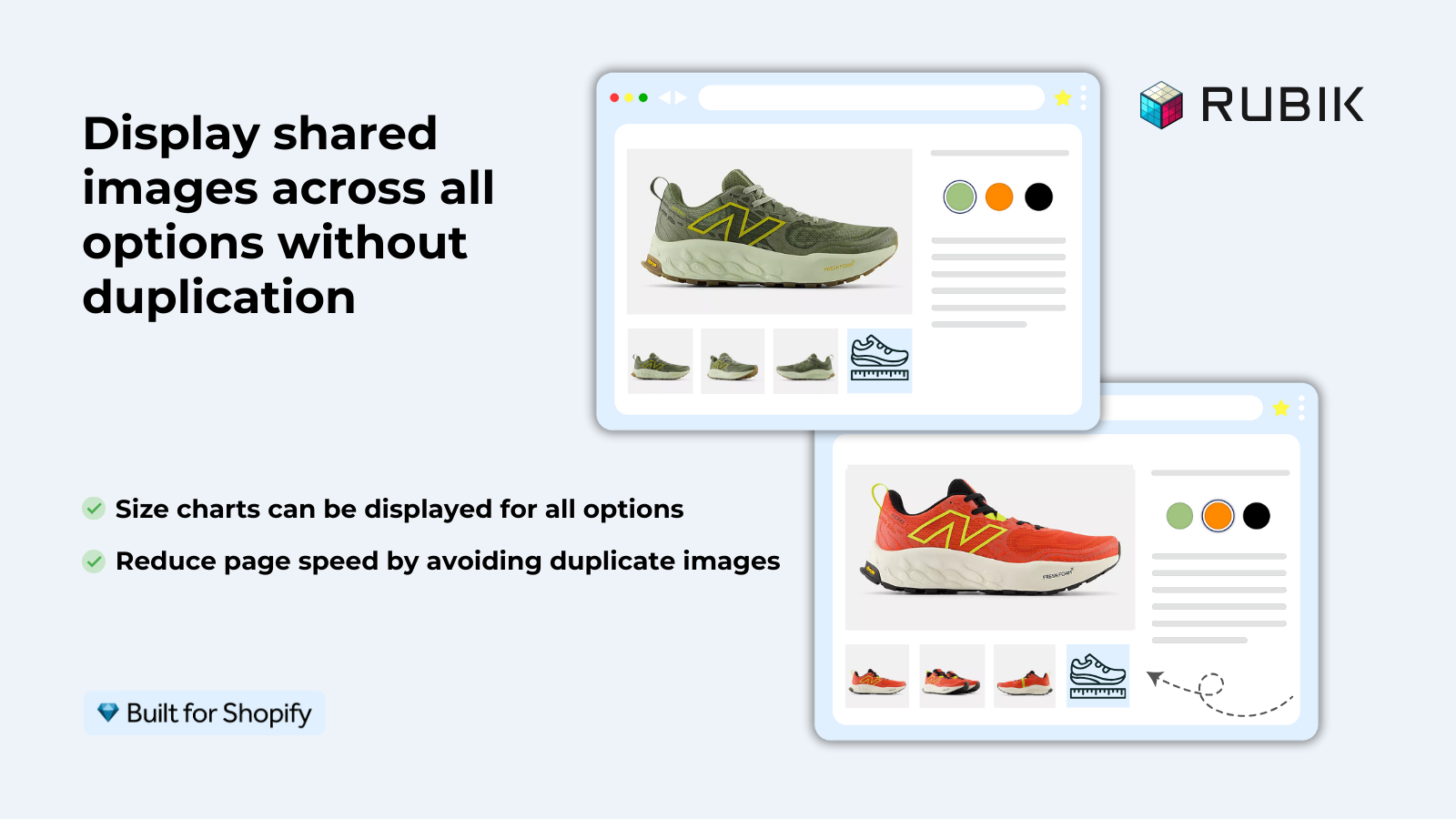
If all your colors live as variants inside one product, you need Rubik Variant Images. If each color is a separate product with its own URL, you need Rubik Combined Listings to link them and show swatches across them. Plenty of stores run both.
Quick gut check. Open your product. Do you see a Color dropdown with Navy, Olive, Red as options on one page? That’s variants of one product, so Rubik Variant Images filters the gallery and shows the right photos. Do you instead have three separate product pages, one per color, each ranking on its own URL? That’s a combined listings job. Rubik Combined Listings keeps each URL (good for SEO) while making them behave like a single product with swatches on the collection page.
And yes, the two work great together. Use Rubik Combined Listings to group your separate color products with collection swatches, then Rubik Variant Images on each product page so the gallery filters correctly when someone clicks through. That combo also gets you past Shopify’s 100-variant ceiling without paying for Shopify Plus.
If your colours live as separate products rather than variants of one product, Rubik Combined Listings groups them into a single listing with swatches instead. Free to install, 5.0 stars across 78 reviews.
Native Shopify vs Rubik Variant Images
Native Shopify gives you one featured image per variant and no way to hide the rest. Rubik Variant Images gives every variant a full media set and filters the gallery. Here’s the side by side.
| Capability | Native Shopify | Rubik Variant Images |
|---|---|---|
| Images per variant | One featured image | Multiple (front, back, detail, lifestyle) |
| Videos and 3D models per variant | No | Yes |
| Hide mismatched photos when a variant is selected | No | Yes, gallery filters automatically |
| Color and image swatches | Limited, theme dependent | Image, color, and pill swatches |
| Hide sold-out variants | No | Yes |
| Bulk assignment across many products | No | Yes, gallery-order bulk assign |
| AI auto-assign | No | Yes, per product |
| Product card swatches on collection pages | Theme dependent | Yes (opt-in) |
The app is metafield-based with no external API calls, so the media data loads with the page itself. It runs on 350+ themes and the major page builders (Beae, EComposer, Foxify, GemPages, Instant, PageFly, Replo). If you’re on Dawn, here’s our Dawn theme variant images guide.
“We’ve tried several solutions for managing variant images, but Rubik Variant Images stands out. It’s like giving our product pages a much-needed declutter. Customers now see only the images that match their selection, which has noticeably reduced the ‘Is this the right color?’ support queries. The setup was intuitive, and the results were instant. It’s one of those behind-the-scenes tools that quietly makes a big difference. Love it!”
Livspace Home, India, 2025-07-10, Rubik Variant Images on the Shopify App Store
If you want to compare options first, we keep an honest roundup in our best Shopify variant image apps review, and a count of how many images per variant Shopify actually supports.
See it live in the demo store, watch the tutorial video, or read the getting started guide.
Frequently asked questions
Which Shopify app should I use for one image per variant?
Rubik Variant Images, built by Craftshift, is the app we build for this. It holds 5.0 stars across 436 reviews and carries the Built for Shopify badge. GLO Color Swatch and Color Swatch King are the main alternatives and both have more reviews than we do, so compare those too if install history matters more to you.
Can you add more than one image per variant in Shopify?
Not natively. Shopify’s variant field holds a single featured image. To add more than one image per variant, you need an app like Rubik Variant Images, which assigns a full media set per variant and filters the gallery so only that variant’s photos show.
Why does Shopify only let me pick one image for each variant?
Because the variant image field was built to set a single featured thumbnail, not to hold a gallery. There’s no native one-to-many link between a variant and several photos, so the dropdown only lets you choose one.
How do I hide the images that don’t match the selected variant?
Install Rubik Variant Images and assign each photo to its variant. When a shopper selects a color, the app filters the product gallery so the mismatched photos disappear and only the chosen variant’s media remains. No theme code needed.
Does this work with videos and 3D models too?
Yes. Rubik Variant Images assigns images, videos, and 3D models per variant, and filters all of them in the gallery when a variant is selected. It’s not limited to photos.
I have 500 products. Do I have to assign images one by one?
No. Use bulk assign, which groups images by your existing gallery order across the whole catalog in the background. For tricky individual products, AI auto-assign handles them per product by reading titles, option values, filenames, and alt text.
What if each color is a separate product instead of a variant?
Then you want Rubik Combined Listings, which links the separate products and shows swatches on collection and product pages while keeping each color’s own URL. Many stores run Combined Listings plus Variant Images together.
Will adding multiple images per variant slow my store down?
It shouldn’t. The app is metafield-based with no external API calls, so the variant media data loads with the page rather than waiting on a separate server request.
Does it work on my theme?
Most likely yes. Rubik Variant Images supports 350+ themes including Dawn, Horizon, Prestige, and Impulse, plus the main page builders (Beae, EComposer, Foxify, GemPages, Instant, PageFly, Replo). If your custom theme needs mapping, support handles it.
Related reading